

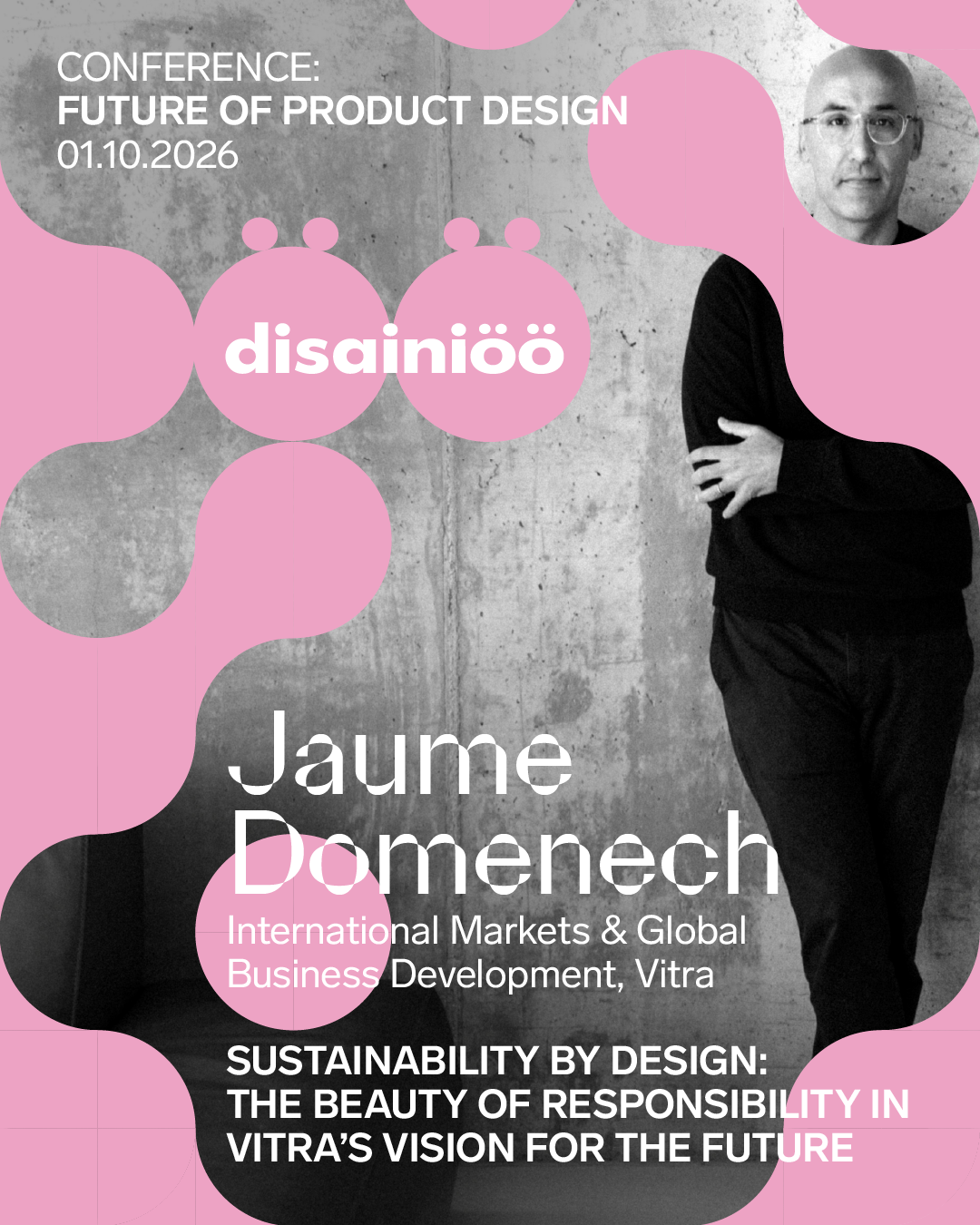
Jaume Domenech: “Perhaps the designer’s role becomes even more fundamental — deciding what deserves to exist.”
Jaume Domenech, Senior Vice President at the furniture design company Vitra, will be in Estonia this autumn as part of Tallinn Design Festival. He will serve as a jury member for the Estonian Design Award BRUNO and speak at the international conference “Future of Product Design” on 1 October at Põhjala Factory in Tallinn.
How can we create products that are genuinely sustainable and built to last? What responsibility do designers carry today? And what does Domenech hope to discover in Estonian design?
We spoke with him about longevity, sustainability, responsibility and the changing role of the designer.
What does “responsibility by design” mean to you, and what do you think designers should be responsible for today?
For me, responsibility by design means understanding that every design decision has consequences. What material do I use? How much of it? Can the product be repaired? Can it adapt? Will somebody still want to use it in twenty years?
Designers have always shaped how things look and function. Today, their responsibility goes further. They also influence how resources are used and how long products remain relevant.
And I would add one thing: responsibility cannot sit only with the designer. Manufacturers must provide the engineering, materials and processes that allow responsible ideas to become real products.
Responsibility by design is ultimately a shared responsibility.
Sustainability is becoming an increasingly important part of product design. What is the biggest challenge in making it a genuine part of the design process rather than simply a trend or marketing message?
The biggest challenge is that sustainability is very easy to communicate and much harder to engineer.
Changing a material is visible. Building a product that can be repaired for twenty years is much less visible, but probably much more important.
The real test is whether sustainability changes the decisions you make when nobody is looking: materials, construction, number of components, separability, spare parts, logistics and refurbishment.
When those decisions change, sustainability becomes part of the product. When only the story changes, it is marketing.
Vitra has a long history of creating products designed to last. How is the idea of longevity changing the way we should think about product design today?
I think longevity changes the question we ask designers.
Instead of only asking, “How can we reduce the footprint of this product?”, we should also ask, “How can we avoid having to produce another one?”
A product with a very low initial footprint is not necessarily sustainable if it has to be replaced every five or ten years.
Longevity therefore has two dimensions. The product has to physically survive: it must be repairable, serviceable and adaptable. But it also has to emotionally survive. People must still want it.
This is where good design becomes extremely relevant. Some Vitra products have been in continuous production for decades and are still being used, repaired and passed from one generation to another.
For me, that is circularity in its simplest form: keep the product in use.
You are also joining the jury of the BRUNO design competition. What are you looking forward to seeing from Estonian designers, and what qualities make a design stand out internationally?
I don’t have a pre-checklist of what Estonian design should look like. Actually, I hope to be surprised.
What I will look for is clarity. A strong design normally has a very clear idea behind it. You understand why it exists, why it has this form and why these materials were chosen.
International relevance does not mean designing something that could come from anywhere. Often it is the opposite. The most interesting products have a very specific point of view but address a need that people can understand anywhere.
And finally, I will look for longevity. Not only: “Can this product last?” but also: “Will we still want this product around us in twenty years?”
From your perspective, what makes Estonian design distinctive or interesting in the wider European and international design landscape?
What interests me about Estonia is the combination of a very strong craft and material culture with a society that is also remarkably contemporary and digitally driven.
That tension is interesting for design: tradition without nostalgia, and technology without necessarily losing materiality.
Estonia is also a relatively small market. I don’t necessarily see that as a limitation. Smaller design cultures can sometimes develop a clearer identity because they don’t need to follow the same industrial logic as larger markets.
What I would be interested to see is how the next generation of Estonian designers translates that context into products that are locally rooted but internationally relevant.
Looking ahead 10–20 years, what do you think product design will look like, and what role will designers play in shaping how we live and work?
I don’t think the future of product design will necessarily be about creating more products. It may be about creating fewer, better and more adaptable ones.
Products will need to change over time: components can be replaced, materials recovered and functions adapted. That means designers will increasingly have to think about systems and product lifecycles, not just finished objects.
Technology and AI will certainly change how products are developed. But I don’t think that reduces the importance of designers. It may do the opposite.
If technology gives us thousands of possible solutions, somebody still has to decide which one is worth making.
So perhaps the designer’s role becomes even more fundamental: not only designing objects, but deciding what deserves to exist.
Hear Jaume Domenech live in Tallinn on 1 October at the Tallinn Design Festival international conference “Future of Product Design” at Põhjala Factory.
The conference brings together leading international designers, thinkers and industry professionals to explore how technology, AI, sustainability, materials and changing expectations are shaping the future of product design.